Adverse possession lets someone who takes over part of another person's land become its legal owner once the owner's time to sue runs out. The occupation must be real, visible, exclusive and without the owner's permission, and it must last without a break for the period state law sets: 5 years in California, 21 in Ohio.
This article is general legal information, not legal advice. Laws vary by state and situation, and reading it does not create an attorney-client relationship. For advice about your case, talk to a licensed attorney.
Key takeaways
- Adverse possession runs on the deadline for suing to recover land; when it passes, California, Texas and New York law give the possessor title.
- The basic period is 5 years in California, 7 in Florida, 10 in Texas, Arizona and New York, 20 in Illinois and 21 in Ohio.
- An unbroken chain of title, even one with a recording defect (color of title), cuts the period to 3 years in Texas and Arizona; a recorded deed plus paying the taxes cuts it to 5. In Illinois, good-faith color of title while paying the taxes cuts it to 7.
- California always requires the possessor to have paid the property taxes, and Florida does when the claim isn't founded on a written instrument.
- The owner's permission defeats a claim, and so does a lawsuit filed before the period ends.
- Land owned by the state or a public entity generally can't be taken this way.
How many years adverse possession takes in each state
Each of these states builds adverse possession into its deadline for suing to recover land, so the periods below are how long the owner has to sue.
| State | Basic period | Shorter period, and what it takes | Possessor must pay property taxes? | Statute |
|---|---|---|---|---|
| California | 5 years | None; a written instrument changes how much land counts as possessed, not the time | Yes, every tax levied during the 5 years, proved by certified county tax collector records | Cal. Code Civ. Proc. 318, 322-325 |
| Texas | 10 years, if the possessor cultivates, uses or enjoys the land | 3 years under title or color of title; 5 years under a registered deed (not a quitclaim or forged deed) while using the land and paying taxes | Only for the 5-year route | Tex. Civ. Prac. & Rem. Code 16.024-16.026 |
| Florida | 7 years | None; with a written instrument recorded with the clerk (color of title), the tax and return rules don't apply | Without color of title, yes: pay within 1 year of moving in, file a return with the property appraiser, keep paying | Fla. Stat. 95.12, 95.16, 95.18 |
| New York | 10 years | None | Not under the statute | N.Y. CPLR 212(a); RPAPL 501, 511-522 |
| Illinois | 20 years | 7 years under good-faith color of title while paying all taxes; for vacant land, 7 years of paying the taxes under good-faith color of title | Only for the 7-year color-of-title routes (13-109, 13-110) | 735 ILCS 5/13-101, 13-109, 13-110 |
| Arizona | 10 years, if the possessor cultivates, uses and enjoys the land | 3 years under title or color of title; 5 years under a recorded deed while using the land and paying taxes | Only for the 5-year route | Ariz. Rev. Stat. 12-523, 12-525, 12-526 |
| Ohio | 21 years | None | Not under the statute | Ohio Rev. Code 2305.04 |
Other states set their own numbers, and an owner's legal disability can stretch them. In Texas, if the owner was under 18, of unsound mind or serving in the armed forces in wartime when the possession began, that time doesn't count, though 25 years ends the owner's right to sue regardless (16.022, 16.027).
The elements, worked through a Texas fence
Say you own a house in Austin. On Saturday, March 18, 2017, your neighbor finishes a cedar privacy fence along your shared side line but sets it 3 feet inside your lot for its whole 100-foot run. He plants raised beds in the 300-square-foot strip on his side, you never go back there, and nobody asks anybody for permission. Because he uses and cultivates the strip, Texas's 10-year statute applies, with no tax requirement (16.026(a)).
| Date | What happens | Effect on the clock |
|---|---|---|
| Sat., March 18, 2017 | Fence finished; neighbor starts gardening the strip | Possession begins and the 10 years start running |
| 2017 to early 2027 | Neighbor keeps the strip as his yard | The clock runs while his possession stays continuous, visible and exclusive |
| Any day before the deadline | You sue to recover the strip | The clock stops: possession interrupted by a suit isn't "peaceable" (16.021(3)) |
| Thu., March 18, 2027 | Last day to file | Ten years after the cause of action accrued (16.026(a)); not a weekend or holiday, so 16.072 doesn't extend it |
| From March 19, 2027 | No suit was filed and every element held | The neighbor has full title to the strip (16.030(a)), though your deed still describes it |
For the claim to ripen in 2027, the neighbor has to prove each element for the whole decade.

Texas defines adverse possession as an actual and visible appropriation of land under a claim of right hostile to the owner's (16.021(1)). The Supreme Court of Texas has said that building a structure may be enough evidence of it, while a mistaken belief about ownership transfers nothing until someone acts on it (Tran v. Macha, 2006). A fence with planted beds behind it is an act anyone could see.
Hostile, and claimed as his own
The neighbor doesn't need to know the strip is yours or mean to take it from you, but he must intend to hold it as his own, to the exclusion of everyone else (Tran). Had he asked to garden there and you'd agreed, his use would be permissive; Ohio's Supreme Court rejected a claim to a side yard partly because the neighbors had asked permission to mow it (Grace v. Koch, 1998). New York sets a different bar: a "claim of right" needs a reasonable basis for believing the land is the possessor's, and de minimis non-structural encroachments, a category that names fences, hedges and sheds, are treated as permissive (RPAPL 501(3), 543).
Exclusive
In Tran, a claim to a driveway failed because two related families had used it together for years, and joint use isn't exclusive. If you'd kept a gate in the fence and mowed the strip every week, the neighbor would have the same problem.
Continuous for the full period
The possession has to run without a break or a lawsuit interrupting it. A later occupant can add an earlier one's years when there is privity of estate between them (16.023), so the neighbor selling his house doesn't necessarily reset the clock.
All four elements are about possession. If the neighbor had only walked across the strip to reach a back gate, his claim would be a prescriptive easement: a right to keep using the path while you keep owning it. Our guide to property easements and the rights they carry covers that use-only claim.
Move the same fence to California and the neighbor would also need certified tax collector records showing he paid every tax levied on the strip for five years (Cal. Code Civ. Proc. 325(b)). In Florida, a claimant without a deed must pay the taxes within a year of moving in and file a return with the property appraiser within 30 days after that, and the appraiser mails you a copy (Fla. Stat. 95.18(1), (4)).
How owners stop a claim
Each of these steps works only if you take it before the period ends.
- Give permission in writing. Permitted use isn't hostile, so a short agreement you both sign, saying the fence stays where it is by your permission until you say otherwise, removes the hostility the claim depends on.
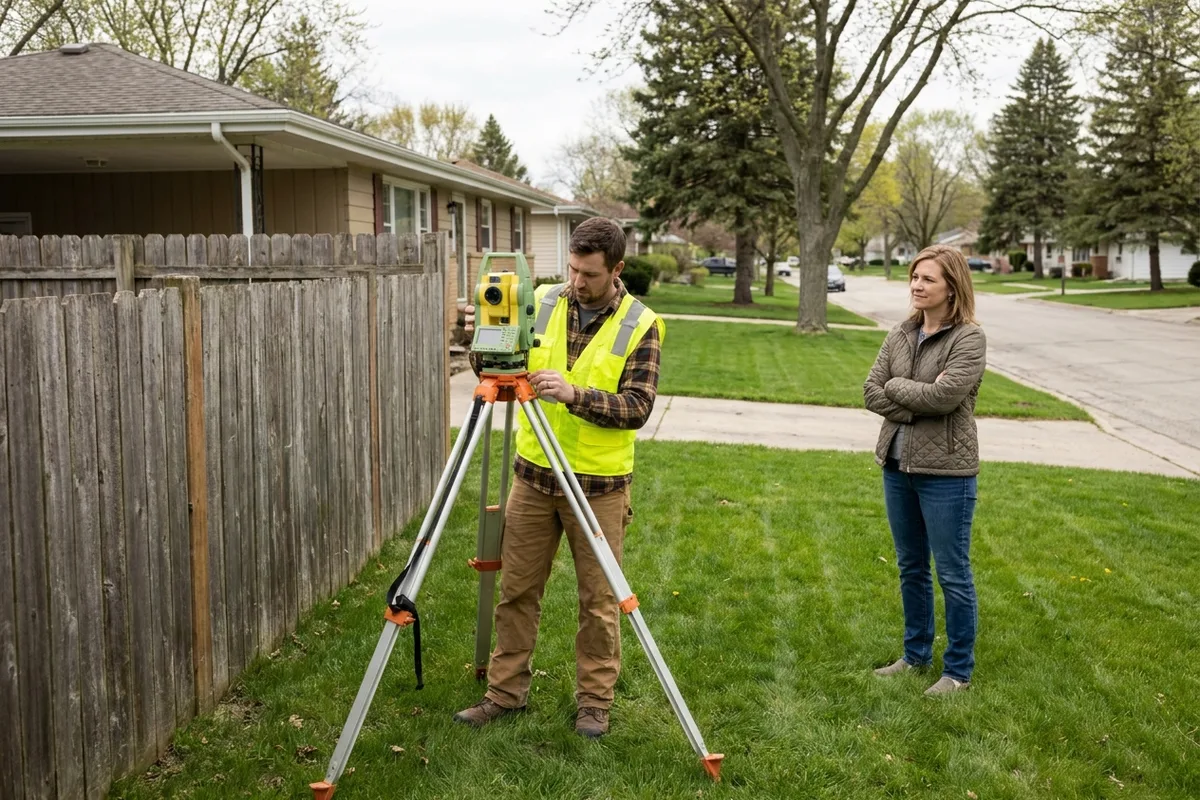
- Get a survey. A licensed surveyor can show whether a fence, driveway or shed sits on your side of the line, which tells you whether any clock is running.
- Keep paying your property taxes and open mail from the assessor. In Florida, an owner's tax payment made before April 1 after the year of assessment has priority over an adverse possessor's, and a receipt showing you paid during the claimed period gets the claim's notation taken off the tax roll (95.18(4)(b), (7)(d)).
- Record or post a notice where your state allows it. A notice recorded under California Civil Code 813 is conclusive evidence that later use is by permission in disputes over prescriptive rights and public dedication; it must also be sent by registered mail to a specific private user, it doesn't undo rights already vested, and while it's in effect you may not block the public use it allows. California (Civil Code 1008) and Illinois (13-122) also honor signs posted at each entrance or every 200 feet. These are written for use claims, so pair them with the steps above.
- Sue before the deadline. A suit to recover the land interrupts the possession. In Texas, an owner who wants attorney's fees must first send a written demand to vacate by registered or certified mail at least 10 days before filing, warning that if the person doesn't leave within 10 days the court may order them to pay costs and attorney's fees; an owner who wins back possession gets fees if the court finds the claim groundless and made in bad faith, and may get them otherwise (16.034).
Government land is usually exempt
In California, no possession of land owned by the state or any public entity can ever ripen into title (Civil Code 1007). Texas bars adverse possession of land dedicated to public use and exempts the state, counties, cities and school districts from its adverse possession deadlines (16.030(b), 16.061). Illinois's 7-year color-of-title routes don't reach state, federal or school land, or land held for a public purpose (13-111).
Nothing is filed when the period ends, and the county records still name the original owner. To get a judgment that can be recorded, the claimant usually brings a quiet-title action. In California it runs this way:
- The claimant files a verified complaint with the land's legal description and street address, the basis of the claimed title and, for adverse possession, the specific facts behind it (Cal. Code Civ. Proc. 761.020).
- On filing, the claimant records a notice of the pending action with the county recorder (761.010(b)) and names everyone with an adverse claim as a defendant (762.010).
- The court can't enter a default judgment. Even if the owner never answers, the judge must hear evidence of the claimant's title (764.010), including the tax collector's certified records.
- The judgment binds the parties and anyone whose claim wasn't of record when the notice was filed, except claims the claimant knew of or that a look at the property would have revealed (764.030, 764.045).
When a property lawyer should look at the boundary
Call one as soon as you have a concrete reason to think the line and the use don't match:
- A survey for a sale, refinance or new fence shows a structure on the wrong side of the line, yours or your neighbor's.
- A neighbor says the strip is theirs because it has been fenced that way for years.
- A Florida property appraiser sent you a copy of an adverse possession return, or your parcel's tax record shows a notation about one.
- The period may be close to running. In the Texas example, the owner's last day to sue is March 18, 2027.
Bring your deed, any survey, dated photos of the fence or structure, and your tax bills. Then compare real estate lawyers in your area and ask how often each handles boundary and quiet-title cases. If a firm offers a free first meeting, our guide to what happens at a free lawyer consultation covers what to ask.
Frequently asked questions
Can a tenant claim adverse possession of the place they rent?
Usually not, because a tenant is there with the owner's permission. California and New York say so directly: a tenant's possession counts as the landlord's until 5 years (California) or 10 years (New York) after the tenancy ends or, with no written lease, after the last rent payment (Code Civ. Proc. 326; RPAPL 531). Only then can a former tenant start holding adversely, and the full period runs from that point.
If I just bought my house, does the clock start over?
No. Years that ran against the seller count against you. California asks whether the owner suing, or a predecessor or grantor, possessed the land within the 5 years before the suit (Code Civ. Proc. 318), and New York asks the same about the plaintiff or a predecessor in interest within 10 years (CPLR 212(a)). A survey before closing is the way to catch an encroachment that has been running for years.
Is adverse possession the same as squatters' rights?
"Squatters' rights" is a loose name for adverse possession, and it gives no one a right to move into a house today; the full period and every element still apply. Florida adds penalties: occupying a residential structure on an adverse possession claim before filing the return with the property appraiser is trespass, and offering that home for rent is theft (Fla. Stat. 95.18(9), (10)).
Can a relative take over inherited family land this way?
In Texas, yes, under a 2017 law. Heirs who inherited shares without a will (by intestate succession) can acquire the other heirs' shares after 10 continuous years of exclusive possession and use while paying the taxes within two years of when they come due, if no other heir contributed or objected. They must record affidavits of heirship and adverse possession, publish notice for four consecutive weeks and send notice by certified mail. The other heirs then have five years to file a controverting affidavit or sue (16.0265).
How hard is it to prove adverse possession in court?
It takes strong proof. Ohio requires clear and convincing evidence of every element for the full 21 years; when its Supreme Court adopted that standard in 1998, it counted 33 states and the District of Columbia using it or a variant (Grace v. Koch). Failing any one element defeats the claim, and Texas's highest court has said the parties' intentions must be very clear before land changes hands this way.
Sources & references
- Texas Civil Practice and Remedies Code, chapter 16, subchapter B (sections 16.021-16.034) and sections 16.061 and 16.072
- Supreme Court of Texas: Tran v. Macha, No. 04-1107 (December 1, 2006)
- California Code of Civil Procedure sections 318-326 (adverse possession) and 760.010-764.045 (quiet title)
- California Civil Code sections 813, 1007 and 1008
- Florida Statutes chapter 95, including sections 95.12, 95.16 and 95.18
- New York Real Property Actions and Proceedings Law article 5 (sections 501-543) and CPLR 212
- Illinois Code of Civil Procedure, 735 ILCS 5/13-101 to 13-122
- Arizona Revised Statutes sections 12-521 to 12-526
- Ohio Revised Code section 2305.04: Recovery of real estate
- Supreme Court of Ohio: Grace v. Koch, 81 Ohio St.3d 577, 1998-Ohio-607
Video: A Closer Look
Third-party video for general background. It is not legal advice or an endorsement.
Talk to a Real Estate attorney near you
This guide is general information, not legal advice. For help with your specific situation, connect with a licensed attorney — many offer a free first consultation.
Find Real Estate Lawyers Near YouReal Estate lawyers by state
Firms our directory lists for real estate in the states where we have the most.